
Tequila vs Mezcal: What Is Actually Different?
Walk into a good bar anywhere in Texas and both bottles are on the shelf, usually within reach of each other, usually explained badly. Tequila and mezcal are cousins with a shared ancestry and two very different sets of rules, and the difference is easier to understand than the bar chatter suggests. Here is what actually separates them.
Is all tequila mezcal?
Tequila and mezcal are both distilled agave spirits from Mexico, and for centuries the word mezcal simply described any distilled agave, tequila included. Today tequila and mezcal are two separate legally protected categories, each with its own denomination of origin, its own production standard, and its own regulatory council, so a bottle certified as tequila is not sold or regulated as mezcal.
You will hear the old line repeated confidently: all tequila is mezcal, but not all mezcal is tequila. As history it is honest enough, because tequila grew out of the broader family of Mexican agave distillates. As a description of the law it no longer holds: the two categories were formally separated, each given its own protected territory and standard, and a producer today certifies for one or the other.
That certification is not a formality. Tequila is overseen by the Consejo Regulador del Tequila, the CRT, which verifies agave, production, and labeling; mezcal has its own council doing the equivalent work for its category. Two spirits, two traditions, two bodies defending them.
What agave is tequila made from, and what agave is mezcal made from?
Tequila may be made from only one plant: blue Weber agave, botanically Agave tequilana Weber, blue variety. Mezcal may be made from many different agave species, most commonly Espadín, along with varieties such as Tobalá, Tepeztate, and Madrecuishe, which is why mezcal varies far more from bottle to bottle than tequila does.
A single permitted species is a discipline, not a limitation. Everything a producer can control (soil, altitude, harvest timing, how the piña is cooked) has to be expressed through that one plant, which is why two tequilas can taste so different while sharing an identical botanical starting point.
Mezcal takes the opposite approach and treats agave diversity as the point. Espadín is cultivated and reliable; the wild varieties are rarer and slower growing, which is why a bottle of Tobalá can taste unlike anything else on the shelf and be priced accordingly. Neither approach is better.
Where can tequila and mezcal legally be made?
Tequila may legally be produced only in the Mexican state of Jalisco plus specified municipalities in Guanajuato, Michoacán, Nayarit, and Tamaulipas. Mezcal has a separate denomination of origin covering Oaxaca and a number of other designated Mexican states, a territory that has been expanded more than once since the designation was created.
Within the tequila territory, growers talk about two landscapes. The lowlands around the town of Tequila sit on dark volcanic soil and tend to give an earthier, more herbal agave. The highlands, Los Altos de Jalisco, are higher, cooler, and red with iron-rich clay, and the agave there is typically larger and sweeter, giving fruit-forward, floral tequila. Mar Azul agave is grown and distilled in the Jalisco highlands, where that softer character in the glass begins.
Why does mezcal taste smoky and tequila usually does not?
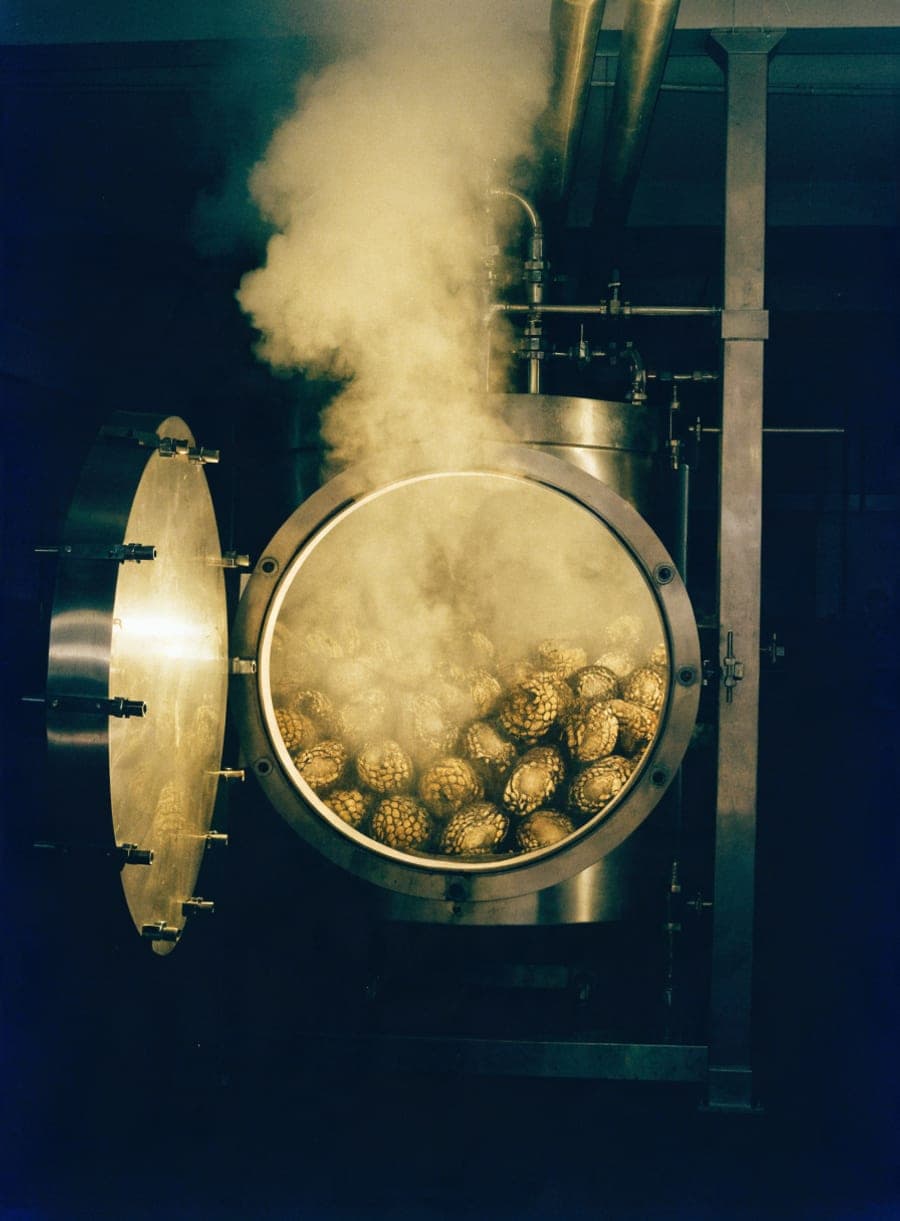
Mezcal usually tastes smoky because the agave hearts are traditionally roasted in earthen pits lined with hot rocks and burning wood, and the smoke from that fire perfumes the agave before it is ever fermented. Tequila agave is normally cooked with steam, in masonry ovens or in stainless steel autoclaves, and steam carries no smoke, which is why most tequila has no smoky note at all.
This is worth saying plainly because it is so often misunderstood: the smoke in mezcal is not a flavoring added at the end. It is a consequence of the fire used to cook the plant, absorbed by the agave fiber and carried all the way through fermentation and distillation into the bottle. Change the oven and you change the spirit.
It also cuts both ways. Not every mezcal is a bonfire; plenty are delicate, floral, and only faintly smoked, and the assumption that mezcal means heavy smoke does the category a disservice. On our side, Mar Azul agave is steam cooked in an autoclave, which is precisely why our tequila is clean and fruit-forward rather than smoky. If you want the long version, how we cook our agave is a story in itself.
How is tequila made differently from mezcal?
Tequila and mezcal follow the same four stages (cook the agave, crush it, ferment the juice, distill it) but tend to diverge at every one. Mezcal production leans traditional and small scale: pit roasting, crushing under a stone tahona, open-air fermentation with wild yeast, and distillation in small pot stills. Tequila production leans toward steam ovens or autoclaves, mechanical milling, stainless steel fermentation, and larger stills or columns.
- ·Agave: tequila uses blue Weber only; mezcal uses many species, Espadín most often.
- ·Region: tequila comes from Jalisco and specified municipalities in four other states; mezcal comes from Oaxaca and a number of other designated states.
- ·Cooking: steam ovens or autoclaves for tequila; wood-fired earthen pits for traditional mezcal.
- ·Typical character: tequila runs clean, citrus, pepper, and cooked agave; mezcal runs smoky, mineral, and vegetal.
- ·Oversight: the CRT certifies tequila; a separate council certifies mezcal.
None of this is absolute. There are tequila houses still using stone tahonas and open fermentation, and there are large, modern mezcal operations. What is reliable is the direction each tradition pulls.
Is mezcal stronger than tequila?
Neither mezcal nor tequila is inherently stronger than the other. Both categories are commonly bottled somewhere between roughly 35% and 55% alcohol by volume, and the strength of any given bottle depends on how that particular spirit was distilled and proofed rather than on which category it belongs to. The alcohol percentage printed on the label is the only reliable answer.
Mezcal earns its reputation honestly, though, because many traditional producers bottle above the category minimum rather than diluting down to it, and because smoke and intense agave read on the palate as force even when the proof is ordinary. Intensity of flavor and percentage of alcohol are two different measurements.
What do the age statements on tequila and mezcal labels mean?
Tequila uses four aging classes: Blanco (unaged or nearly so), Reposado (rested in oak for a matter of months), Añejo (aged at least a year in oak), and Extra Añejo (aged considerably longer). Mezcal uses three: Joven, Reposado, and Añejo, and Joven, the unaged style, is the one most mezcal drinkers reach for because it shows the agave and the roast most clearly.
Oak does the same work in either category: it rounds the edges, adds vanilla and caramel, and trades some brightness for depth. In our house, the Reposado rests six months in American white oak and the Añejo waits eighteen months in Kentucky white oak, which is a deliberate choice about how much wood we want speaking over the agave. Across our eleven expressions, three are aged Reserva bottlings and eight are the Sabores line.
Should you use tequila or mezcal in a cocktail?
Tequila is the more flexible cocktail base, because a Blanco brings citrus, pepper, and cooked agave without overpowering lime, grapefruit, or bitters, which is why margaritas and palomas are built on it. Mezcal brings smoke and pronounced agave character that dominates a drink, so it works best either as a small accent alongside tequila or as the deliberate centerpiece of a cocktail designed around smoke.
A practical trick from behind the bar: build the drink on tequila and float a quarter ounce of mezcal on top. You get the smoke on the nose, where you notice it most, without losing the fruit and lime underneath. Our cocktail recipes take the same approach: one voice leads, the rest support.
For sipping, the advice reverses. Mezcal rewards a small pour in a wide glass, at room temperature, with nothing added; the whole point is the roast and the particular agave. Tequila sips beautifully too, and the aging class is your guide: Blanco when you want the agave bright and unmasked, Reposado when you want it softened, Añejo when the evening has slowed down.
Tequila and mezcal are not rivals. They are two answers to the same question: what do you do with a plant that took seven years to be ready?
The House of Mar Azul Tequila
The best way to learn the difference is the obvious one: pour a small measure of each, side by side, and pay attention to where they separate. You will find the smoke first, then the sweetness, then the finish. Whichever bottle you reach for afterward, you will be reaching for it on purpose.
Common questions
- Can an agave spirit made outside Mexico be called tequila or mezcal?
- No. The names tequila and mezcal are protected designations of origin tied to specific regions of Mexico, so a spirit distilled from agave anywhere else cannot legally carry either name. Agave spirits made in the United States, South Africa, Australia, and elsewhere are sold under general terms such as agave spirit.
- What does 100% agave mean on a tequila label?
- A tequila labeled 100% agave is fermented and distilled entirely from blue Weber agave sugars, with nothing else fermented into the spirit. Tequila without that statement, often called mixto, may derive up to 49% of its fermentable sugars from other sources, most commonly cane sugar.
- Are there other Mexican agave spirits besides tequila and mezcal?
- Yes. Mexico produces several other regional agave distillates, including bacanora from Sonora and raicilla from parts of Jalisco, each with its own local traditions and, in some cases, its own protected designation. These spirits are made in far smaller volumes than tequila or mezcal and are worth seeking out if a bar carries one.
- Is the worm in the bottle a mezcal thing or a tequila thing?
- The larva, known as the gusano, appears in some mezcal bottlings and never in certified tequila. Adding it is a mid twentieth century marketing tradition rather than a mark of quality, and most respected mezcal producers do not use it.
- How should tequila be served if not as a shot?
- Good 100% agave tequila is best served neat at or slightly below room temperature, in a narrow glass such as a Riedel tequila glass or a small copita, and sipped slowly. Salt and lime were developed to mask harsher spirits and are unnecessary with a well made bottle.
- Is Mar Azul Tequila smoky like mezcal?
- No. Mar Azul cooks its 100% blue Weber agave with steam in an autoclave rather than roasting it over wood, so there is no smoke in the spirit at any stage. Expect cooked agave, citrus, and gentle sweetness instead, with oak character in the Reposado and Añejo.