
How Is Tequila Made? Every Step From Agave to Bottle
Between a field in Jalisco and a glass in Texas sit seven or eight distinct steps, and each one leaves a mark on the finished spirit. Almost every question people ask about tequila (why it costs what it costs, why one bottle tastes of pepper and another of caramel, what the words on the label actually promise) is answered somewhere in that sequence. So here is the sequence, in order.
What is tequila actually made from?
Tequila is made from the cooked and fermented sugars of a single plant: blue Weber agave (Agave tequilana Weber, blue variety). Mexican law also limits where tequila may be produced, to the entire state of Jalisco plus specified municipalities in Guanajuato, Michoacán, Nayarit, and Tamaulipas. A spirit made from any other agave, or made anywhere else, cannot legally be called tequila.
That protection is called a denominación de origen, the same idea that reserves the word Champagne for one region of France. Compliance is not left to good faith. The Consejo Regulador del Tequila (CRT) inspects distilleries, verifies each batch against the national standard, and certifies what leaves the gate.
Within that territory, growers talk about two broad terrains. Los Altos, the volcanic highlands where our agave grows, sits in red iron-rich soil, and its agave is often described as sweeter and more floral. The lowland valley around the town of Tequila tends toward a more earthy, herbaceous character. Neither is better. They are different starting points.
How long does agave take to grow before it can be made into tequila?
Blue Weber agave takes roughly six to ten years to mature before it is ready to be harvested for tequila. During those years the plant slowly stores carbohydrate in its core, and it is cut only once: an agave is harvested a single time and does not grow back.
Growers help that process along. As the plant nears maturity it tries to send up a quiote, a tall flowering stalk that would consume the sugar the plant has spent a decade accumulating. Field crews cut the quiote off so the sugar stays where it belongs, in the heart.
That single fact shapes the whole industry. A grower planting today is betting on a market almost a decade away, which is why agave prices swing so dramatically between shortage and surplus, and why patience here is less a marketing word than an accounting problem.
How are the agave piñas harvested?
Agave for tequila is harvested by hand by a worker called a jimador, who uses a long-handled flat blade called a coa to shear away the plant's spiny leaves until only the dense core remains. That core is the piña, named for its resemblance to a pineapple, and a mature one commonly weighs somewhere between 80 and 200 pounds.
No machine has replaced this. Ripeness is read plant by plant, by eye and by feel, from the color of the leaves, the tightness of the center, the way the plant sits in the soil. Two agaves planted the same week in the same row can be ready a year apart, and only a person walking the field can tell.
The cut itself matters to flavor. Leaving too much leaf base attached carries bitter, waxy compounds into the oven; shaving too close wastes sugar. How closely a distillery asks its jimadores to trim is a genuine stylistic decision.
How is the agave cooked to make tequila?
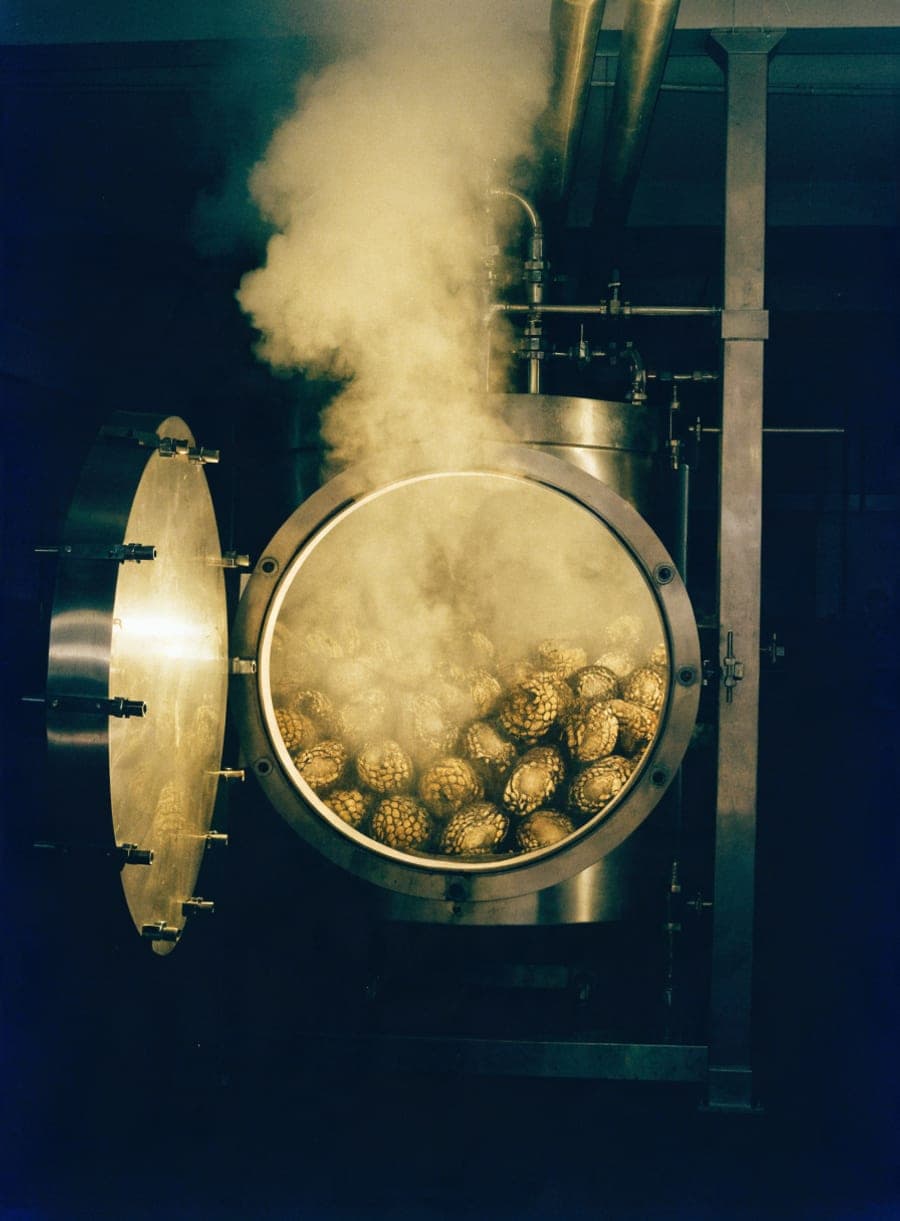
Agave is cooked with heat and steam to convert inulin, the long-chain carbohydrate stored in the plant's dense core, into the simple sugars that yeast can ferment. Raw agave contains almost nothing a yeast can eat, so without cooking there is no tequila. Distilleries cook agave in three main ways: traditional brick ovens known as hornos, pressurized stainless steel autoclaves, and diffusers.
- ·Hornos: masonry ovens where halved piñas cook in low-pressure steam for a day or two, then rest. The slowest method, and the one most associated with deep caramelized, almost baked-sweet-potato notes.
- ·Autoclaves: sealed steel pressure ovens that cook the same piñas in a matter of hours, evenly, with tight control over temperature. Faster than a horno, and far gentler than a diffuser.
- ·Diffusers: industrial machines that shred raw or barely cooked agave and strip the sugars out with hot water, often with acid, cooking the extracted liquid afterward. The highest yield, and the most debated for what it leaves behind in the glass.
Mar Azul cooks its agave in an autoclave, a sealed steel oven where pressurized steam reaches every fiber at the same rate. Even cooking is the whole point: scorched fibers carry bitterness forward into fermentation, and undercooked ones simply never give up their sugar.
Cooked agave still has to give up its juice. Traditionally that was done with a tahona, a great stone wheel that crushes the fibers in a circular pit; most distilleries today use a roller mill instead. What comes off is a sweet, dark juice. What is left behind is bagazo, the spent fiber.
How is tequila fermented?
Tequila is fermented by adding yeast to the sweet juice pressed from cooked agave, which converts the sugars into alcohol over a period that usually runs from about two days to a week. The fermented wash, called mosto, is a low-strength agave beer of well under ten percent alcohol, and it is what gets distilled into tequila.
Fermentation is where a surprising amount of a tequila's aroma is decided. Yeast does not only make alcohol; it throws off esters and other aromatic compounds that read in the finished spirit as tropical fruit, citrus peel, green herbs, or fresh bread. Change the yeast and you change the tequila, even if every other step stays identical.
Producers make three choices here, and each one is audible in the glass: whether to use a proprietary cultivated yeast or let ambient wild yeast take over, whether to ferment in open wooden vats or closed stainless tanks, and whether to leave some bagazo in the tank, which lends a rustier, more vegetal edge. Cooler and slower fermentations generally build more aromatic complexity than warm, fast ones.
How is tequila distilled?
Tequila must by law be distilled at least twice. The first pass turns the fermented agave wash into a cloudy, low-proof liquid called ordinario; the second concentrates and refines that liquid into clear tequila. During the second pass the distiller discards the first and last portions of the run, known as the heads and tails, and keeps only the heart.
Where the distiller makes those cuts is the single most consequential judgment call in the building. Cut narrow and you get a cleaner, lighter spirit and lose volume. Cut wide and you keep more character along with more of the rough compounds that character rides in on. There is no formula, only a trained palate and a house style.
Equipment matters too. Copper pot stills strip sulfur compounds and tend to give a rounder spirit; stainless columns run faster and lighter. What emerges is clear, unaged, and diluted with water to bottling strength. Mexican regulation permits tequila to be bottled anywhere from 35 to 55 percent alcohol by volume, though most bottles land at 38 to 40 percent.
What does aging do to tequila, and how long is each class aged?
Aging tequila in oak trades some of the agave's raw, peppery brightness for color, softness, and wood-derived flavors such as vanilla, caramel, and baking spice. The classes are defined strictly by time in wood: Blanco is unaged or rested less than two months, Reposado two to twelve months, Añejo one to three years, and Extra Añejo more than three years.
The barrel is not a neutral container. Most tequila rests in American white oak that previously held bourbon, which arrives already charred and already carrying vanillin and caramelized wood sugars. Heat pushes the spirit into the staves and cool nights draw it back out, so a warm cellar ages faster than a cool one and time alone never tells the whole story. Mar Azul Reposado rests six months in American white oak, and the Añejo waits eighteen months in Kentucky white oak.
You will also see Cristalino on shelves. A Cristalino is an aged tequila, usually an Añejo or Extra Añejo, that has been filtered until it runs clear again, keeping much of the barrel's sweetness while losing the color. It is a modern style rather than an older tradition, and worth knowing so the clear liquid in the bottle does not mislead you into expecting a Blanco.
What does 100% agave mean on a tequila label?
A tequila labeled 100% agave is fermented and distilled entirely from blue Weber agave sugars, with no other sugar added before or during fermentation. A tequila without that phrase is a mixto, which may take as little as 51 percent of its fermentable sugars from agave and up to 49 percent from other sources such as cane sugar.
The distinction carries a practical consequence: tequila sold as 100% agave must be bottled in Mexico, inside the region of origin, while mixto may be shipped abroad in bulk and bottled elsewhere. If a label does not say 100% agave, it is a mixto, because no producer entitled to the phrase leaves it off.
Two more marks are worth finding on any bottle. Every legitimate tequila carries a NOM number, a four-digit code identifying the certified distillery that produced it, and a CRT certification mark confirming the batch was verified. Mar Azul is 100% blue Weber agave, grown and distilled in the highlands of Jalisco.
Knowing the sequence changes how a bottle reads. The peppery snap of a Blanco is fermentation and the still; the vanilla in a Reposado is six months of oak; the price on the shelf is a decade of sun. Pour it neat first, so you can taste all of that, and then build it into a cocktail once you know what you are working with.
Common questions
- What is the difference between tequila and mezcal?
- Tequila must be made from blue Weber agave within its own denomination of origin, while mezcal may be made from dozens of different agave species and carries a separate denomination covering Oaxaca and several other Mexican states. Mezcal agave is also frequently roasted in underground earthen pits, which is where its characteristic smokiness comes from; tequila is steamed rather than smoked.
- What is the NOM number on a tequila bottle?
- The NOM number is a four-digit code printed on every legitimate bottle of tequila that identifies the certified distillery where the tequila was produced. Several different brands can share one NOM number, because a single distillery may produce tequila for more than one label.
- Does tequila keep aging after it is bottled?
- No. Tequila stops maturing the moment it leaves the barrel, because aging depends on contact with wood. An unopened bottle of Añejo will taste much the same in ten years as it does today, provided it is stored upright, away from heat and direct sunlight.
- Can tequila legally be made outside of Mexico?
- No. Tequila is a protected denomination of origin, and it may only be produced in the Mexican state of Jalisco plus designated municipalities in Guanajuato, Michoacán, Nayarit, and Tamaulipas. An agave spirit distilled anywhere else must be sold under a different name.
- Are additives allowed in tequila?
- Mexican regulation permits tequila to contain up to one percent by weight of four approved additives: caramel coloring, oak extract, glycerin, and sugar syrup. These are used to adjust color, sweetness, and texture, they do not have to be declared on the label, and many producers use none at all.
- What is a tahona, and how is it different from a roller mill?
- A tahona is a large stone wheel, traditionally pulled in a circle through a shallow pit, that crushes cooked agave to release its juice. A roller mill does the same job mechanically and much faster by pressing and rinsing the fibers between rollers, which is why most modern tequila distilleries use one.


